Building a Modern React-Based Car Rental Platform
Sigvi set out to create a smarter way to rent cars across Lithuania that would match today’s digital expectations. Our goal was to turn this idea into a platform that could handle real-time bookings, secure payments, and personalised delivery with a convenient interface.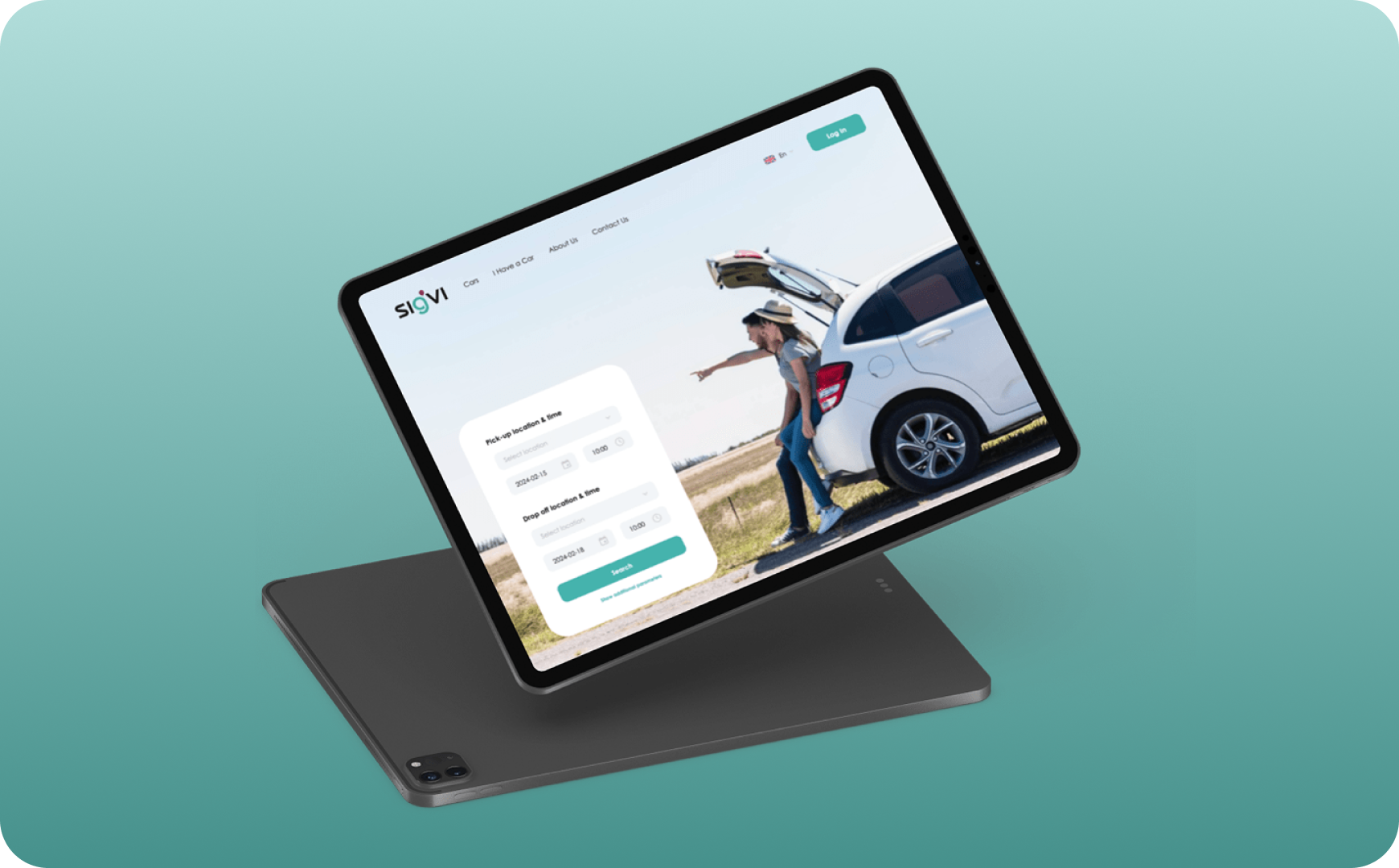
About the Project
Client’s Needs
What We Delivered
We partnered with the product team to design and develop the platform’s full architecture that will keep every layer working together towards speed and flexibility. Our responsibility was to create a connected system with modern design and strong engineering.
Front-end side
-React.js/Redux
React.js was chosen for its component-based architecture, facilitating modular development. Redux served as the state management library, ensuring predictable state changes and efficient data flow.
-JavaScript/TypeScript
JavaScript and TypeScript provided the scripting capabilities needed for dynamic and interactive user interfaces.
-React Hooks
Engineers employed useState, useEffect, and custom hooks to streamline stateful logic, resulting in cleaner and more maintainable code.
-API Integration
Our team established robust API connections, using asynchronous calls to fetch and update data in real-time, ensuring a responsive user interface.
Back-End Development
-Python/Django
Python served as the core programming language, while Django provided a high-level web framework for rapid and efficient development.
-Redis
We integrated Redis into the system, caching data strategically to reduce response times and enhance overall platform speed.
-GeoIP
The GeoIP library was integrated into the platform to determine users' geographical locations, enabling personalised content and services.
-Docker
Engineers created Docker containers encapsulating the application and its dependencies, promoting scalability and simplifying deployment processes.
-Nginx
Nginx was configured to act as a reverse proxy, directing requests to the appropriate backend components and optimising resource utilisation.
-XMPP and SMTP
We integrated XMPP for real-time communication and SMTP for email notifications, ensuring a comprehensive and reliable messaging system.
-Celery
Celery was employed for task processing, enabling the execution of asynchronous and scheduled tasks.
-PostgreSQL/Django REST Framework
Engineers designed and implemented the database schema using PostgreSQL, and Django REST Framework was utilised to expose APIs, allowing seamless communication between the front-end and back-end.
Payment Gateway Integration
-Research:
Engineers conducted extensive research to identify a suitable payment gateway, considering factors such as security, ease of integration, and support for the client's preferred payment methods.
-Integration:
The selected payment gateway was seamlessly integrated into the Django back-end, utilising APIs and SDKs provided by the payment service provider.
-Testing:
Rigorous testing was conducted to ensure the secure and error-free processing of transactions. This involved simulated transactions, error-handling scenarios, and stress testing.
-Optimization:
The payment process was optimised for speed and reliability, ensuring a smooth and efficient experience for users.
-Scalability:
The solution was designed to scale horizontally to accommodate increased transaction volumes, with the architecture capable of handling growing user demands.
Driving Results
By embracing both web and mobile environments, we enhanced the solution’s accessibility, catering to a broader audience and accommodating diverse user preferences for an efficient and user-centric car rental experience. The system now flawlessly processes bookings, payments, and deliveries, so that the company can focus on scaling its business instead of managing technical bottlenecks.