Safe Automation for a Complex AI Legal System
Ranking Copilot simplifies one of the most painful processes in legal marketing: directory submissions. Our role focused on improving product stability and ensuring that complex AI-driven workflows could evolve safely through automated testing.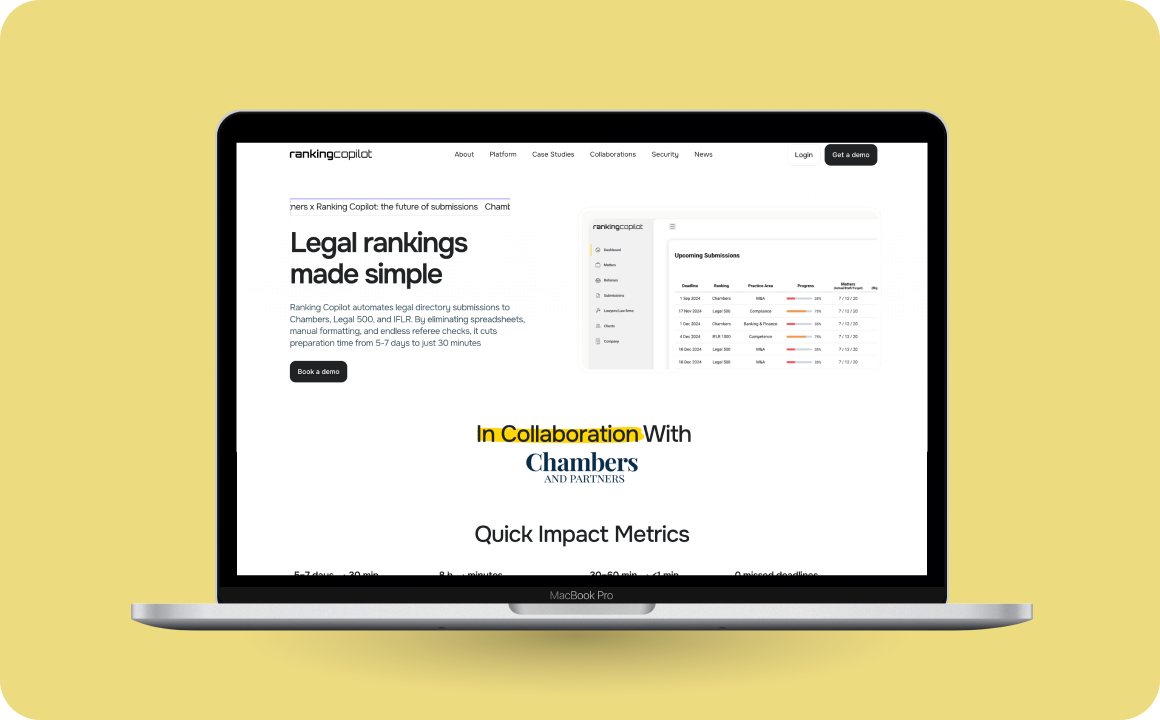
About the Project
Client’s Needs
How We Approached the Project
The solution centralises matters, lawyers, clients, and referees in one secure workspace. Teams then reuse the same structured data across multiple directories. Thus, firms can move from data entry to export-ready documents much faster, without compromising quality control.
Given the numerous edge cases and rules and high level of product logic, we built our testing approach entirely on automation. This allows end-to-end coverage to grow with the platform.
Scaling quality through automation
The product logic spans AI-generated content, document exports, and country-specific submission rules. In this complex setup, even a small change could affect multiple areas at once. Full manual verification would take days and still leave room for missed edge cases. Automated testing made frequent and safe iterations feasible. With repeatable end-to-end checks, core workflows could be validated quickly and consistently.
Alongside automated testing, the team actively supported quality assurance through manual and exploratory checks. Test cases and bug tracking were managed in Jira and Confluence. Browser DevTools were used to validate UI behaviour, network requests, and console errors in complex AI-driven flows. Postman supported manual API checks and basic response validation. Git was used to review test changes and track updates in the codebase.
Functional and regression testing complemented automated coverage during release preparation. New AI features were validated through functional checks. Regression testing checked whether submission flows remained stable before each release.
E2E testing foundation
We built full-cycle testing using Cypress JavaScript to create a structure that could grow with the product. From the start, we designed the suite to reflect real submission workflows and cover the most valuable user paths. Because the platform includes many interdependent scenarios, the test architecture was built to stay maintainable as coverage expands.
Test architecture for complex flows
To support a product with many rules, screens, and branching scenarios, we designed the tests to be modular and reusable. This made it easier to extend coverage without rewriting the same steps across different cases. We worked closely with the platform’s Next.js and React interface logic to validate critical user interactions in realistic conditions. The approach helped ensure that updates across the UI behaved consistently from a user’s perspective.
Parallel test execution
As the test suite grew beyond 150+ cases, we organised parallel test execution so feedback stayed fast and practical for the team. This allowed the project to keep a strong testing signal even as more product scenarios were added. We structured test runs to fit the development rhythm, so checks could happen regularly without slowing delivery.
Business Impact
QA automation created a reliable testing foundation for a logic-heavy AI legal platform. Critical submission workflows became consistently verifiable. This significantly reduced the risk of regressions across country-specific rules and document generation scenarios.
Improved test coverage and structured regression checks strengthened release stability at the product level. Feature rollouts became more predictable, with stable system behaviour during customer onboarding.
Automated end-to-end checks replaced time-consuming manual verification. Complex changes can be validated without turning testing into a bottleneck. As a result, the team gained clearer feedback on product changes and higher confidence in everyday iterations.