Scaling and Improving the Language Web App
Kandor is an online educational platform that helps students prepare for language exams through structured practice tests, real-time interactions, and guided learning tools. Our goal here was to help every Kandor learner study smarter and build great confidence in how the app helps in that.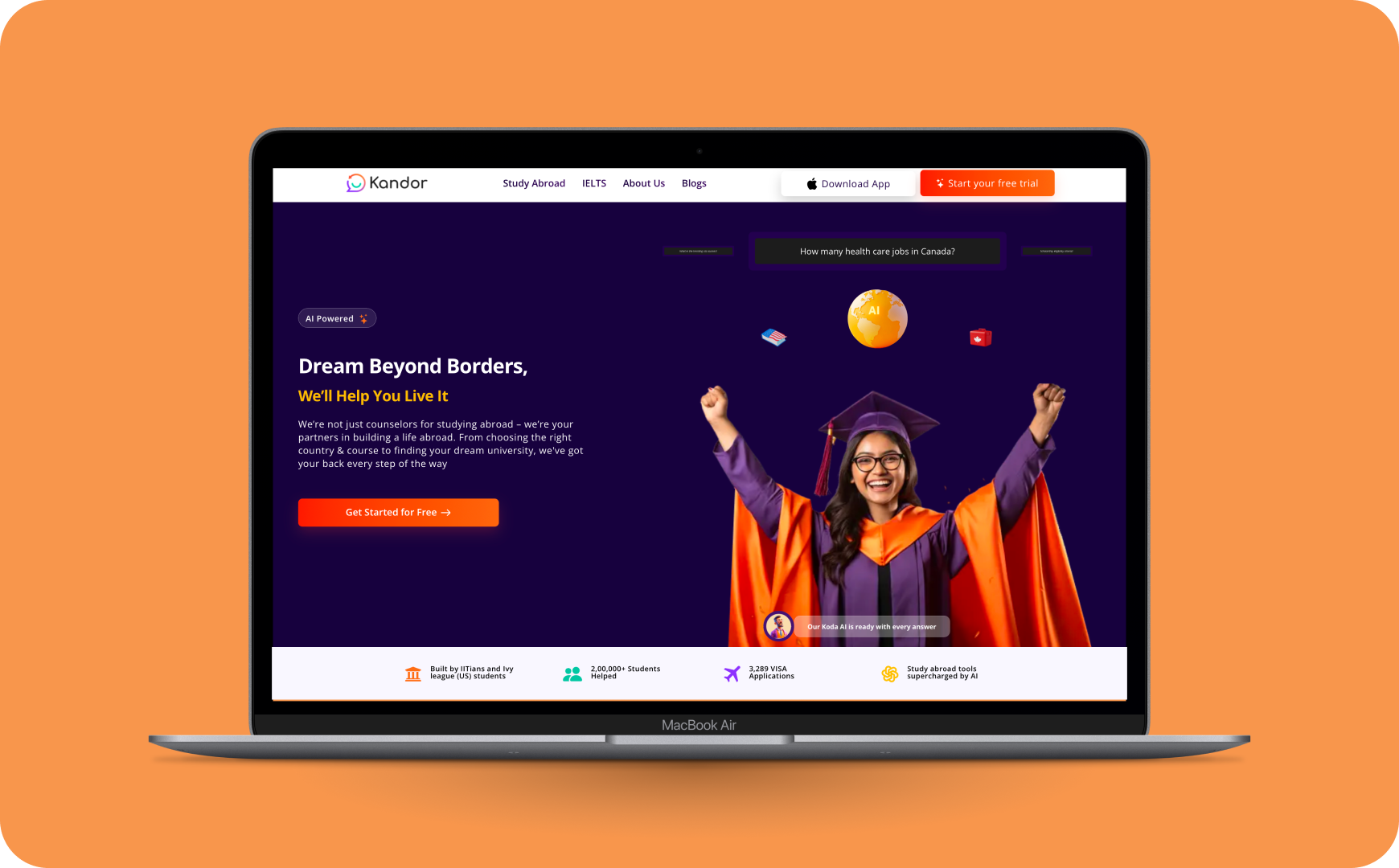
About the Project
Client’s Needs
Our Approach to Improvements
The team joined the project during an intensive support and optimisation phase. We kept the focus on debugging, improving visual consistency, and boosting performance across the platform.
Core technologies we worked with
Our work was targeted at strengthening the React-based foundation of the application. We worked with React, React Router, and Redux, along with CSS/SCSS, Bootstrap, ANDT, Axios, Fetch, and Socket.IO. This stack allowed us to modernise the interface, stabilise the logic behind component rendering, and improve how data moved through the system.
SDK integration & UI fixes
One of the most demanding tasks involved integrating the Zoom SDK. The SDK created layout distortions, misaligned interface elements, and inconsistent behaviour across browsers. To resolve this, we developed a custom Higher-Order Component (HOC) that standardised how the SDK behaved throughout the application.
This approach allowed us to correct styling conflicts, normalise resizing and rendering behaviour, improve event handling, and stabilise interactions during live practice sessions.
Real-time features
Using Socket.IO, we strengthened the platform’s real-time communication layer. This improved the responsiveness of interactive practice sessions and made exam simulations behave consistently under increased load.
Performance & UX improvements
As part of the optimisation work, we addressed a wide range of issues affecting rendering stability, state management, and API-driven behaviour. Page transitions became smoother, component logic became more predictable, and error cases were significantly reduced.
Business Impact
Our engineering work helped Kandor significantly improve its platform at a moment of scaling and product expansion. Performance became more consistent, the interface behaved reliably during live sessions, and bugs related to rendering and integrations decreased substantially. Students can now experience a more stable and responsive practice environment, which has led to an overall increase in satisfaction and engagement.
By modernising the architecture and resolving key bottlenecks, we helped create a more scalable foundation for Kandor that supports future features, larger user volumes, and continued growth across new markets.