Ledger Leopard Web App
Web application development for a Web3 blockchain solutions provider focused on practical use cases for startups and enterprises across government, healthcare, and logistics.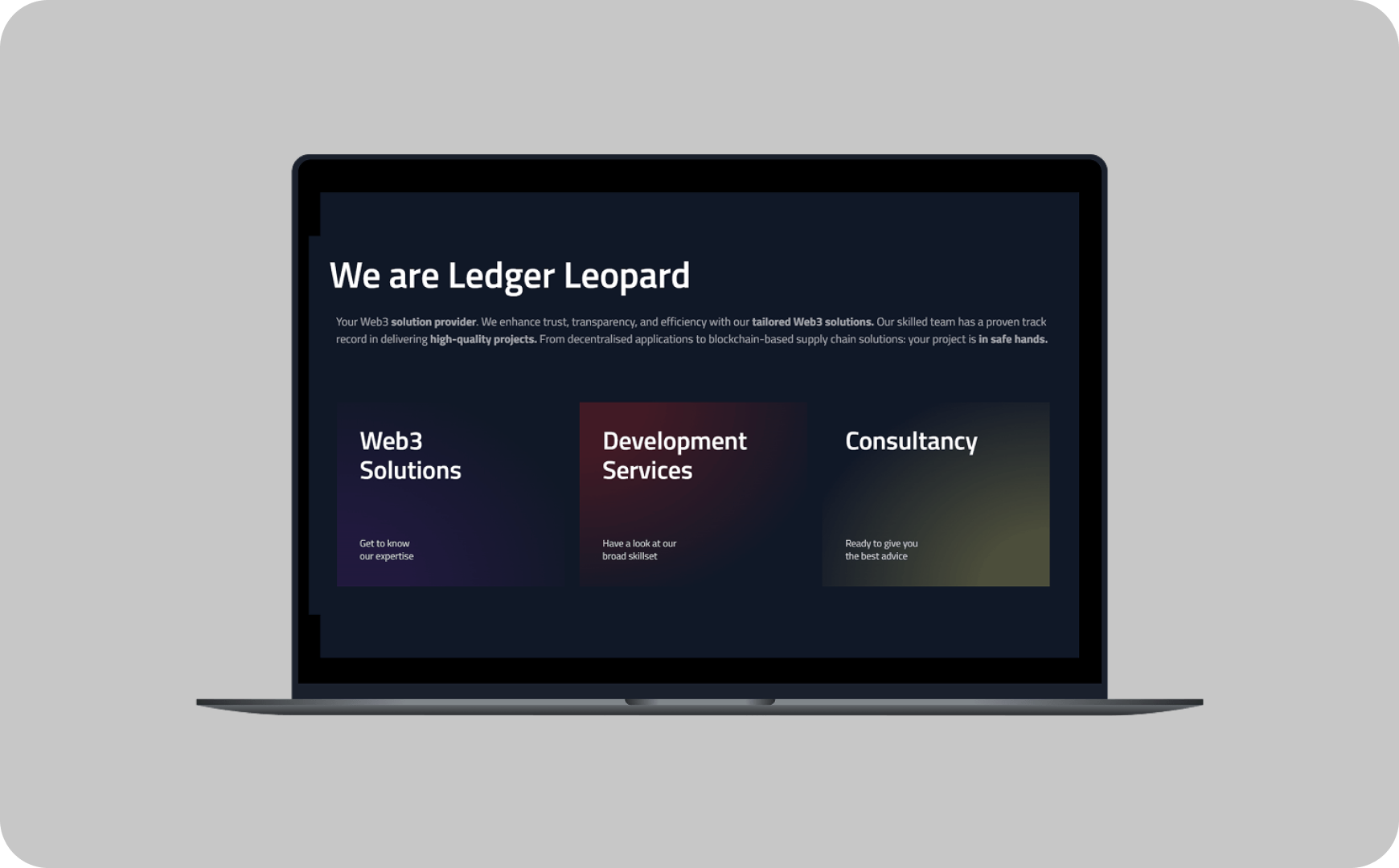
About the Project
Client’s Needs
Our Approach to Web App Development
The web application was built using React, Redux, and TypeScript for predictable state management, code maintainability, and long-term scalability. Blockchain principles were central to the architecture, supporting data integrity and secure transactions. Smart contracts were used to automate key processes and reduce manual intervention.
The initial phase of Ledger Leopard's web app development focused on understanding how users interact with Web3 functionality. That understanding guided architectural decisions and interface design across the platform. The result is a solution that supports the required functionality without unnecessary complexity.
To maintain consistency across the product, we created a design system that defines layout, typography, colour usage, and reusable UI components. This made it easier to build and maintain a consistent interface across the solution.
Key features implementation
Ledger Leopard’s main task was to secure and streamline document verification, access management, and identity management processes. These workflows needed to be reliable, predictable, and easy for users to work with in day-to-day operations. Security considerations were embedded across the application to support reliable data handling and user trust.
The focus was on structuring complex blockchain logic to support real operational use. Advanced functionality was implemented in a way that remains usable, consistent, and aligned with practical business needs.
Web3 Solution Enhancement
Identity management
We established a multi-tiered authentication system, incorporating two-factor authentication (2FA) and decentralised identity (DID) principles. Secure single sign-on (SSO), multi-factor authentication (MFA), and federated logins were introduced to support different access scenarios. User accounts and permission structures were built to manage access, track activity, and support compliance across the platform.
Access management
Our framework included Role-Based Access Control (RBAC) for precise access permissions based on user roles. Robust audit trails tracked user activities comprehensively, and smart contracts were employed for automated and efficient access control in the Web3 environment.
Document verification
We anchored documents onto the blockchain for immutability and timestamped verification. Decentralised document storage and zero-knowledge proofs were implemented to protect sensitive information during document verification processes.
Business Impact
The delivered platform provides a stable Web3 foundation for managing identity, access, and document workflows. Granular access control, audit logging, and automated access logic improved security and reduced manual effort across user interactions.
Following the web application launch, the solution was extended with a React Native mobile app to support cross-platform access. The mobile application reflects the core web functionality and enables users to access decentralised solutions on the go.
The project resulted in a production-ready Web3 solution that supports secure operations, predictable behaviour, and future scalability across both web and mobile environments.